For Future Reference
About
Rose
I like understanding how things work and how they are related to each other. A useful model simplifies while still giving good intuitions about how to successfully interact with the real thing. Observe and adjust if a model is no longer serving its purpose.
When writing software, the coder's mental models are turned back into explicit things. Being functionally correct is necessary, but is not by itself sufficient in a long-lived code base. It takes care to clearly represent both the technical and social contexts the software is situated in so that not just what the code does but how to think about the solution space is communicated to future readers.
This site
This site is built with Astro. It collects what I've learned about software and guidance from others that I've found insightful.
Ferns
The header photo is of a Mariana Maiden Fern taken on the Space Coast of Florida. All nature photos are taken by me unless otherwise noted.
Ferns differ from most land plants in that they neither flower nor produce seeds, and instead reproduce via spores. The spores grow in small clusters called sori, usually on the underside of the frond. The shape and location of the sori can help identify the species of fern.
After the spores are released, if they land in a suitable location, they germinate, growing into small free-living plants called gametophytes. Gametophytes produce male and female reproductive structures. Fertilized eggs then grow as new sporophytes (the plants that we recognise as ferns).
For most ferns, fronds grow from coiled fiddleheads, which in some species are edible.
While often associated with moist environments, some species, such as resurrection ferns, are quite tolerant of desiccation during dry spells, potentially surviving a century in the dry state before springing back to life when rains return.
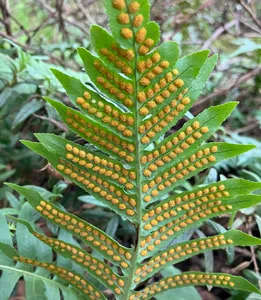 Sori on a Nested Polypody, California
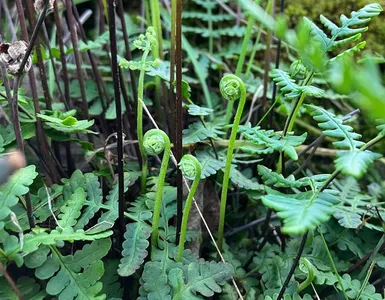 Fiddleheads of a Goldenback fern, California
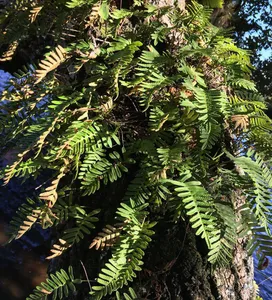 Resurrection ferns, Florida
Not ferns
Mosses also reproduce via spores, and can have similarly shaped leaves to ferns (species in the genus Thuidium are called fern mosses). In contrast to ferns, mosses have simple leaves and lack the complex structures to carry water and nutrients that the vascular plants have.
Cycads have pinnately divided leaves arching from a central core that can resemble ferns or palms. Cycads differ from ferns in having rigid leaves and producing seeds in cones.
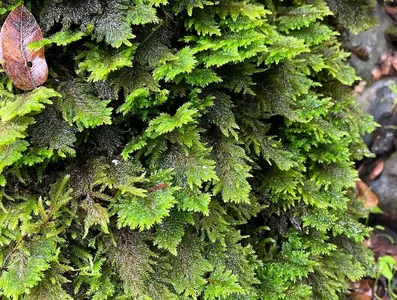 Dendroalsia moss, California
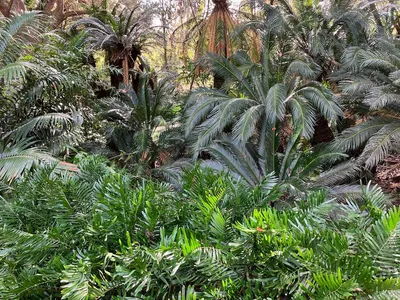 Cycad garden, Florida